


The Magic of Experiencing Fado Music in Lisbon, Portugal
- Emily Fata

- Feb 20
- 10 min read
Discover Fado music in Lisbon, from its soulful history to Alfama District’s intimate venues, and experience Portugal’s most moving tradition firsthand.

There is a moment in Lisbon when the clatter of cutlery fades, the wine glasses stop mid air, and an entire room leans into silence. A single Portuguese guitar begins to shimmer. The singer closes her eyes, and suddenly, you are no longer a visitor in Portugal. You are inside a feeling.
I had travelled to Lisbon for its tiled façades, golden light, and custard tarts still warm from the oven. I did not expect to leave with a lump in my throat because of a song I did not fully understand. That same feeling of longing, romance, joy, sadness, and yearning, wrapped up in a series of musical notes, extends beyond live performances.
There I was in a dimly lit room in a museum in Alfama, completely undone by a voice that carried centuries of longing through an audio. That was what it was like the day I truly understood Fado.
If you are the kind of traveller who wants to feel a place, rather than skim its surface, the experience of Fado belongs on your Lisbon itinerary.
Fado Music in Lisbon: The Origins and History of Fado

To understand Fado music in Lisbon, you have to rewind to the early 19th century, when sailors, dock workers, and market vendors filled the city’s waterfront neighbourhoods with stories and song.
The Tagus River was the city’s lifeline, carrying ships in and out of port, along with news, heartbreak, and hope. In taverns lit by oil lamps and in cramped alleyways where neighbours gathered after long days of labour, voices rose to give shape to feelings that had nowhere else to go.
The genre was born in working-class districts such as Alfama and Mouraria, shaped by hardship and migration, but alive with the pulse of port life. It carried the ache of separation and the poetry of everyday struggles, reflecting lives marked by uncertain incomes, long voyages, and the constant ebb and flow of people passing through.
That emotional undercurrent became known as saudade, a Portuguese word that captures longing as much as nostalgia and a deep love that lingers even in absence. Saudade is not simple sadness—it is layered with memory and desire, with tenderness for something that may never return.
Fado gave that feeling a melody; it turned private grief into communal expression, allowing entire rooms to share in a single story.
Over time, what began as informal performances in taverns evolved into a national art form embraced by all social classes. The history of Fado music reflects Lisbon’s transformation from a gritty maritime hub into a cultural capital that honours its roots, while embracing refinement and artistic excellence.

As the decades passed, Fado gained structure and prestige. Professional singers emerged, developing signature styles and loyal followings. Dedicated venues opened, creating spaces where the music could be performed with intention and respect. Poets crafted lyrics that blended romance, politics, and philosophy, elevating the repertoire beyond spontaneous improvisation.
The dictatorship era of the 20th century added another layer to the genre’s evolution, as Fado navigated questions of identity and expression within a complex political landscape.
By the mid 20th century, artists like Amália Rodrigues brought the genre to international audiences, touring abroad and recording albums that introduced Fado to listeners far beyond Portugal’s borders. Her voice carried the soul of Lisbon into concert halls across Europe and the Americas, shaping how the world perceived Portuguese culture.
What was once neighbourhood storytelling became a symbol of national identity, woven into the fabric of Fado music that Portugal proudly shares with the world. It is a living and breathing reminder that music can hold history within a single, trembling note.
The Sound, Emotion, and Experience of Fado

A Fado performance begins with anticipation: the lights dim, conversations soften, a guitarra portuguesa, with its pear-shaped body and twelve strings, sends bright notes into the air. It is accompanied by a classical guitar, which grounds the melody with warmth and rhythm. Sometimes a bass guitar adds depth, creating a subtle foundation that supports the singer without overpowering the moment.
Then the fadista steps forward, often dressed in black, commanding the room with presence alone. The structure is intimate and deliberate, allowing the lyrics to breathe and the emotion to unfold without distraction. There is no elaborate staging, no dramatic lighting effects, no spectacle competing for attention. The focus rests entirely on story and sound.
The voice is everything. It can be raw or velvety, restrained or soaring, yet always carries an intensity that feels deeply personal. Each phrase stretches and curls around the melody, shaped by careful control and lived experience. Even if you do not speak Portuguese (I don’t), the emotion is unmistakable.
Watching one video in the Museum of Fado (more on that in a bit), you can see the singer’s eyes close as she reaches the chorus, and the patrons in the room seem to lean toward her. I had no idea what each verse meant, yet I felt every syllable in my chest.

There was a collective stillness that felt almost electric, as though everyone present—whether in the room, in the live performance video, or watching it years later in a museum—understood that something fragile and beautiful was unfolding in real time.
Audience etiquette is important; there is no chatter during the song, plates pause mid-air, staff members freeze respectfully against the walls, and phones disappear out of sight. Even tourists who arrived moments earlier sense that this is not the time for whispered commentary. Applause erupts only after the final note fades, breaking the silence like a wave.
Experiencing live Fado in Lisbon is not about background music drifting through a dining room, but rather, is about presence, about giving your full attention to a voice that carries generations of memory. Travellers quickly realize they are participants in something sacred, drawn into a ritual that has shaped Lisbon’s cultural heartbeat for nearly two centuries.
Fado Music in Portugal Today
While Lisbon is its beating heart, Fado music in Portugal extends far beyond the capital’s hills and tiled façades.

The city of Coimbra has its own distinct style, traditionally performed by male singers connected to the historic university. In Coimbra, performances often take place beneath balconies or in academic settings, with singers dressed in black capes that echo student tradition. The tone is typically more restrained and serenade-like, shaped by poetry and intellectual influence.
Regional interpretations across the country continue to shape the genre, each reflecting local character, dialect, and history.
In 2011, UNESCO recognized Fado as Intangible Cultural Heritage of Humanity, affirming its global cultural significance and acknowledging its deep roots in community life. That recognition strengthened efforts to preserve and promote the art form across Portugal, ensuring that future generations inherit both the music and the stories behind it.

Today, traditional Portuguese Fado coexists with contemporary experimentation in ways that feel organic, never forced. Younger artists blend classic instrumentation with subtle modern influences, weaving in new lyrical themes that speak to present-day realities while maintaining the emotional intensity that defines the genre.
Recording studios and digital platforms have expanded Fado’s reach, allowing listeners from Toronto to Tokyo to discover voices from Lisbon’s neighbourhood stages. Festivals throughout Portugal create spaces where established performers and rising talents share lineups, introducing diverse audiences to different interpretations of the art form.
International tours continue to carry Fado across borders, reinforcing its role as one of Portugal’s most recognizable cultural exports.
In Lisbon, this evolution is especially visible; you will hear seasoned performers who have sung the same repertoire for decades, their voices rich with experience and memory. In nearby venues, emerging singers experiment with arrangement and phrasing, gently reshaping expectations while honouring tradition.
For travellers, this means choice and depth. You can seek out a deeply traditional performance steeped in ritual and candlelit ambience, or attend a concert that feels contemporary and exploratory. Both experiences connect you to Portugal’s evolving identity, revealing a culture that values heritage while welcoming creative growth.
The Museu do Fado in Lisbon

While Lisbon is its beating heart, the Fado music Portugal celebrates is exemplified in one museum in particular, the very place where I learned so much about this musical artform.
Tucked into Alfama near the Tagus River, the Museu do Fado (Museum of Fado) offers something every culturally curious traveller craves.
Context: On my recent rainy weekend trip to Lisbon, after wandering Lisbon’s hills and hearing Fado spill out from tucked-away doorways, stepping into this museum felt like opening the liner notes to a song you cannot stop replaying in your head. It is intimate, rather than overwhelming, and thoughtfully curated, rather than overly polished.
Essentially, it is deeply rooted in the neighbourhood that helped birth the genre.
The museum guides visitors through the evolution of Fado from its 19th-century beginnings to its international acclaim. Photographs line the walls, capturing singers mid-performance, eyes closed and hands pressed to their hearts. Listening stations invite you to hear recordings from different eras, allowing you to trace how vocal styles, instrumentation, and lyrical themes have shifted over time.
Seeing vintage posters and handwritten lyrics adds texture to stories that might otherwise remain abstract. You begin to understand that Fado is not only music, but is also biography, politics, poetry, and memory wrapped into a hypnotic melody.


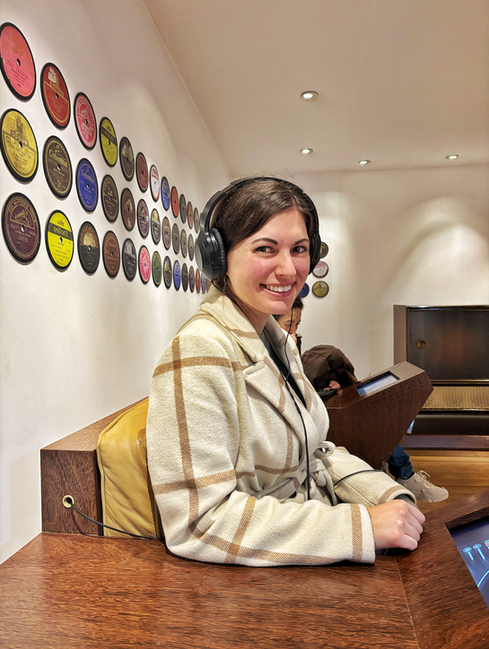
Listening to Fado music inside the Museu do Fado. Photos by Emily Fata (left) and Mariantonietta Gurnari (right).
One highlight is the focus on instrumentation. The Portuguese guitar, with its delicate curves and twelve strings, takes centre stage in several displays. Up close, you can appreciate the craftsmanship that shapes its luminous tone.
The museum explains how the guitarra portuguesa and the classical guitar work together to create the genre’s distinctive sound, offering insight that makes your next live performance even more meaningful. It is one thing to hear the music in a candlelit room, but it is something else entirely to understand how each note is built.
The museum also honours the legends who carried Fado beyond Portugal’s borders. Exhibits dedicated to iconic fadistas reveal the personalities behind the voices, including costumes, personal artifacts, and archival footage to remind you that these were artists navigating censorship and cultural expectation while staying true to their emotional core.
Their stories deepen your appreciation for the resilience embedded in every song.
What I loved most was how accessible the experience felt. The space encourages exploration without feeling didactic; in fact, we went in the “wrong” direction and didn’t realize until we saw a group tour going through at the very end. That’s how intuitive and laissez-faire the navigation is.

Interactive displays and multimedia presentations foster dialogue between past and present, making it easy for visitors new to Fado to feel welcome and never intimidated. You leave with a deeper understanding of the genre’s complexity and an even stronger desire to experience it live, regardless of how short or how long you chose to stay and linger.
Visiting the Museu do Fado before attending a performance transforms the evening.
You recognize references in the lyrics. You hear stylistic nuances that might have slipped past you before. The music becomes layered with meaning. In a city where sound and story intertwine so effortlessly, this museum serves as a quiet yet powerful reminder that Lisbon’s most moving tradition is still unfolding, one song at a time.
Surrounding Alfama District and Traditional Fado Houses
Alfama is where Fado breathes most freely, and even without stepping inside a dedicated music house this time, I could feel it humming through the neighbourhood.
Narrow cobblestone lanes twist uphill in determined zigzags, laundry flutters between sun-faded buildings, and the scent of grilled sardines drifts through open windows with impressive confidence. This is the district that nurtured the genre, and it still carries that intimate, slightly rebellious spirit.
Walking here at dusk feels like stepping onto a film set, except the soundtrack isn't added in post-production. Somewhere around the next corner, someone is likely tuning a guitar.
The Fado houses Lisbon is famous for are woven into these streets, discreet behind wooden doors and tiled façades. As mentioned, I didn’t make it inside one on my recent visit, which gives me every excuse to return. From conversations with locals and the music I experienced elsewhere in the city however, I can already picture the scene.

Tables close enough to encourage accidental elbow taps. Candles flickering with heroic determination against the evening breeze. Plates of bacalhau (cod fish) and grilled meats making their way through the room. Generous pours of vinho tinto, or Portuguese red wine, help everyone lean a little deeper into the mood.
Performers rotate throughout the evening, singing only a few feet from where you sit, with no dramatic stage to create distance. The closeness is all a part of the magic.
Each venue has its own personality; some are polished and elegant, with reservations essential and an ambience that feels quietly formal. Others embrace a family-run charm, where the owner might introduce the singer with visible pride and a story or two. In every case, the focus remains on the music.
Visitors arrive curious and perhaps slightly unsure of what to expect, but they leave having shared in something deeply rooted and profoundly local.
Even without a late-night exit from a traditional Fado house on this visit, I felt the pull. Standing in Alfama as evening settled over the hills, listening to distant notes drift through open windows, I knew I had unfinished business with this city.
Lisbon glowed under soft amber light, ancient and alive all at once. Fado has a way of doing that. It lingers. It calls you back… And I, for one, fully intend to answer.
All in All
If your travels are fuelled by culture and the kind of connective moments that stay with you long after your suitcase is unpacked, make room for Fado on your Lisbon itinerary.
Wander through Alfama. Visit the Museu do Fado. Book a table in one of the city’s intimate music houses. Let yourself sit in silence as the first note rings out.
Lisbon is waiting, and its songs are ready to tell you a story.


Wow! this seems like a place I would definitely want to visit. I appreciate your insights on the wonderful pictures you have captivated.
Dim lights and bright notes...Fado absolutely sounds like my kind of music. I would be so thrilled to experience it when I get to visit Lisbon!
I have always loved Fado and Coimbra music because I was introduced to them as a child.
My parents had close friends from Lisbon and the music became part of their friendship.
It would be nice to add a YouTube sampler to your post as you've delved deep into the subject and a sample would give the reader a quick glimpse into this magnificent, traditional music genre. That said, we now see contemporary iterations and they are beautiful too.
Your description of experiencing Fado in Lisbon beautifully captures how the music becomes more than a soundtrack. It feels like the heartbeat of the city itself, steeped in emotion, history, and soul. I love how you bring the intimate venues, heartfelt performances, and the deep cultural roots of Fado to life in such vivid detail. Thanks for sharing this inspiring look at why hearing Fado live is such a moving and unforgettable part of any Lisbon journey.