


Things to Do in Brescia During a Family-Friendly Day Trip

Spend an afternoon enjoying the best things to do in Brescia, where the city’s layered past remains visible throughout its compact and character-rich centre.

intro
Did you know that Brescia can fill a handful of hours so completely that curiosity follows you all the way home? It’s true!
I arrived expecting a pleasant afternoon walk through a northern Italian city, then found Roman stone woven into the streets and two cathedrals sharing a single square, apparently because Brescia saw no reason to stop at one. Every turn seemed to reveal another century, often with the simplicity of someone casually mentioning that the remarkable thing beside you has been there for a thousand years.
Our Brescia day trip from Bergamo began by train, since Bergamo was our home base and the journey made an easy outing for the three of us. I was travelling with my cousin and her young daughter, which meant our pace followed a very sensible formula: keep everyone fed and let the youngest traveller set the tone for where we would go.

Brescia suited that rhythm beautifully, since the historic centre is compact enough for a leisurely walk, and the route between its major squares unfolds naturally, without requiring some sort of military campaign involving colour-coded maps. Basically, from the station, we could make our way into the centre on foot, so the transition from train journey to sightseeing felt effortlessly straightforward.
By the time we returned to the station in the late afternoon, Brescia’s appeal was evident, and a return visit already felt necessary (and was mentally in the works while I was on the train back).
Nonetheless, an afternoon offered a vivid introduction to a city whose history remains visible within the routines of daily life, including the very important Italian business of eating gelato, and that sense of historically rooted continuity became the most memorable part of the day.
The Things to Do in Brescia Start With Its History
Brescia’s story reaches back more than three millennia, and learning a little of that history before you set foot in the city limits changes the way the modern city looks as you walk through it.
Before the Romans arrived, the settlement was associated with the Cenomani, a Gallic people who made ancient Brixia an important regional centre near Cidneo Hill.
Roman rule gave the city a monumental civic heart, and the Capitolium erected in 73 CE remains one of the clearest signs of the status Brixia once held in northern Italy. The city entered another defining era under the Longobards, particularly in the year 753, when Desiderius, then Duke of Brescia and later king, founded the monastery of San Salvatore, which became part of the incredible Santa Giulia complex.
Venetian rule began afterward, in 1426, and left its visual signature across the city, with Piazza della Loggia expressing the confidence of the Renaissance through pale Botticino marble and architecture shaped by the influence of the Republic of Venice. If you’ve been to Venice before, you’ll notice this architectural style immediately!
Brescia’s strong civic identity became famous yet again during the Ten Days of 1849, when residents resisted Austrian forces from March 23 to April 1, and earned the city its enduring nickname of being “the Lioness of Italy.”

Today, you’ll find that all of these eras remain remarkably close to the surface, meaning that a walk through Brescia can move from pre-Roman origins to the Risorgimento within a compact part of the centre. My cousin shared pieces of the city’s past as we walked through, and hearing its history from someone right beside me made the grand dates feel connected to the streets beneath our feet.
For me, when I have someone telling me about the history of a location while I’m standing in the midst of it, I often feel like I can place myself back in time, trying to imagine what everything would have looked like in that exact spot 100, then 500, then 2,000 years prior. It’s almost like pulling back the layers of the city as you move further back through the centuries.
Brescia easily lets visitors encounter historical layers in open view, because its present-day identity rises across ancient foundations, and the civic centre continues to carry the influence of Venetian rule. Naturally, museums can deepen that understanding considerably, especially at Santa Giulia, where the buildings form part of the actual history being told.
What to See During an Afternoon in Brescia
Anyone hoping to experience Brescia in one day will find that the historic centre offers up a simple route and plenty of opportunities for you to look at the city’s past more closely.

Piazza della Vittoria makes a convenient starting point, since its broad open space introduces a twentieth-century chapter of the city before the surrounding streets lead toward much older ground. If you’re coming from the train station, you can arrive here easily with one metro stop (that is, if you don’t want to walk over and are really strapped for time).
From here, a short walk brings you to Piazza della Loggia, where the clock tower and Palazzo della Loggia give the square a distinctly Venetian character, and narrow lanes carry you onward to Piazza Paolo VI.
The two cathedrals become the architectural centrepiece of the route, with the neighbouring Broletto adding the civic history that once shared this space with religious authority.
Via dei Musei then leads toward ancient Brixia, where the Capitolium rises above the remains of the Roman forum and the Teatro Romano sits close behind it. A longer Brescia itinerary could easily include the Santa Giulia Museum and Brescia Castle, both of which deserve enough time to appreciate the stories held within them. In fact, when I come back, I’d love to spend a night here and visit all the museums I can!
Santa Giulia occupies a former monastic complex and traces the city’s history across approximately 14,000 square metres (around 150,695 square feet), making it the kind of museum that benefits from a generous schedule. The castle offers yet another reason to stay longer, since its position on Cidneo Hill places Brescia’s story within a broader view of the city and a stunning sunset lookout spot.

Fun fact: Brescia and Bergamo shared the title of Italian Capital of Culture in 2023, which gave our rail journey between them a sense of connection.
Actually, my first summer visit to Italy was during this year, and there was a giant screen in Bergamo that broadcast live to a giant screen in Brescia, allowing the two cities to see each other in real time! After three years, I was able to visit the city with my feet on the ground.
Our afternoon focused on the walkable centre and the sights we could experience without rushing through an admission gate, letting the city itself guide the day.
The pleasure came from watching one period blend into the next along streets that still feel lived in, and from realizing how much history can fit within a relatively small area. Brescia gives short visits real substance, and its museums provide a convincing reason to plan out another day to come back.
A Sweet Walk Through Brescia’s Historic Squares
We began in Piazza della Vittoria, where the imposing geometry of Fascist-era architecture provided an impactful setting for a very contemporary family ritual: McDonald’s lunch.
Travelling with a child has a way of revising sophisticated culinary plans, and there is something charming about eating familiar fast food in an Italian piazza before setting off to study several thousand years of civilization. Honestly, I love a good nostalgic McDonald’s stop, even though there are minimal vegetarian options for me.

A gelateria nearby allowed us to follow up our lunch with a gelato, providing (what we deemed) both fuel and excellent diplomatic leverage against a little girl to encourage her to take on the walk ahead.
That all said, Architect Marcello Piacentini designed Piazza della Vittoria, which opened in 1932 after the medieval Pescherie quarter was demolished during a sweeping Fascist-era redevelopment. Knowing that story gives the square a complicated historical weight, which remains present during an easygoing stop with a child happily fed and ready to continue (even if, no, we didn’t explain fascism to her).
From there, we wandered through the central streets until Piazza della Loggia opened in front of us, framed by the Renaissance Palazzo della Loggia and the Torre dell’Orologio across the square (to which, I obviously cried out, “Ah! Look! An astrological clock!”). The astronomical clock has marked time here since the sixteenth century as two mechanical figures strike the bell above it.
Yes, I also want one for my house.
The piazza also holds memories that are far more recent; a bomb exploded during an anti-fascist demonstration on May 28, 1974, killing eight people, and the square remains a place of civic remembrance as well as daily public life.
My cousin told me more about Brescia as we continued, and the city’s history felt especially present when delivered in conversation during an ordinary afternoon. We followed the streets toward Piazza Paolo VI, passing façades and shopfronts at a pace that gave us room to notice how naturally and nonchalantly Brescia carries its past.

Piazza Paolo VI eventually appeared in our sightline, with the Duomo Nuovo rising over the square and the circular Duomo Vecchio hugging it close by. That approach became one of my favourite parts of the day—the piazze joined into a continuous story, with each one carrying us further through Brescia’s timeline.
Even the McDonald’s lunch belonged to that story, proving that family travel can place ancient civic spaces and modern lunch negotiations in the same perfectly enjoyable afternoon.
Inside Brescia’s Duomo Nuovo and Duomo Vecchio
Before entering the cathedrals, we stood outside the Broletto and admired the Fontana della Minerva in Brescia (also known as the Minerva Armata, in English), which was built in 1818 and sculpted from Botticino marble by the Veronese artist Giambattista Cignaroli.
The Broletto itself, right behind it, provides a quiet introduction to the city’s former seat of government, while the Piazza Paolo VI brings civic and religious history into the same frame. Interestingly, Brescia is the only Italian city with two cathedrals occupying the same square, which makes this corner of the centre feel especially remarkable, before either threshold is even crossed.

Duomo Nuovo commands your attention through its sheer scale; its construction began in 1604 on the site of an earlier basilica and continued until the cathedral was completed in 1825.
Its massive dome, among the tallest in Italy, gives the interior an upward pull that makes visitors instinctively lift their eyes (it’s 80 metres, or about 262 feet, high). Plus, the Botticino marble façade lends the building a stately presence from across the square.
It was absolutely stunning inside, and we enjoyed wandering around and admiring the art within. Unfortunately, no photography is allowed, but take my word that it was gorgeous and definitely worth visiting.
We then entered the Duomo Vecchio, also called La Rotonda, whose circular Romanesque form dates from the beginning of the twelfth century and creates an immediate sense of age. Inside La Rotonda, the rounded stone interior draws attention inward and encourages a slower kind of looking.

Beneath the cathedral are traces of earlier sacred buildings and a Roman bath, and the crypt of San Filastrio belonged to the church that occupied the site before La Rotonda took shape.
Visiting both cathedrals in succession makes Piazza Paolo VI feel like a condensed architectural history lesson, and space and light provide the teaching.
Their proximity also creates one of those travel experiences that seems almost too convenient, since centuries of religious architecture are waiting side by side with no complicated transportation required. We emerged into the same piazza with a much clearer sense of how Brescia has continued to build upon its own past, preserving earlier foundations as part of the city that people continue to use today.
Walking Through the Roman Ruins in Brescia

Ancient Brixia began announcing itself before we reached the main archaeological park, since fragments of the Roman city appeared along our walk with very little ceremony.
The most impressive remains are clustered around the Parco Archeologico di Brescia Romana, or Brixia - Archaeological Park of Roman Brescia, where the Capitolium and the Republican Sanctuary preserve the monumental centre of a city that flourished under Rome. The Teatro Romano extends behind them, its surviving curve allowing you a glimpse of the scale that public entertainment once reached here.
Much of the site can be appreciated from the surrounding public spaces, and standing outside the Capitolium still gives a powerful sense of its presence against the current streets. The archaeological area forms part of the UNESCO World Heritage property connected with Longobard places of power, joining Roman remains to the later history represented by San Salvatore and Santa Giulia.
During our visit, the admission option was an integrated ticket covering the archaeological area and several civic museums, which offered far more culture than we could reasonably absorb in the time they had remaining for our afternoon trip. I decided to save the full experience for a return visit, when I can actually give proper attention to the Capitolium interior and the Winged Victory displayed within it.
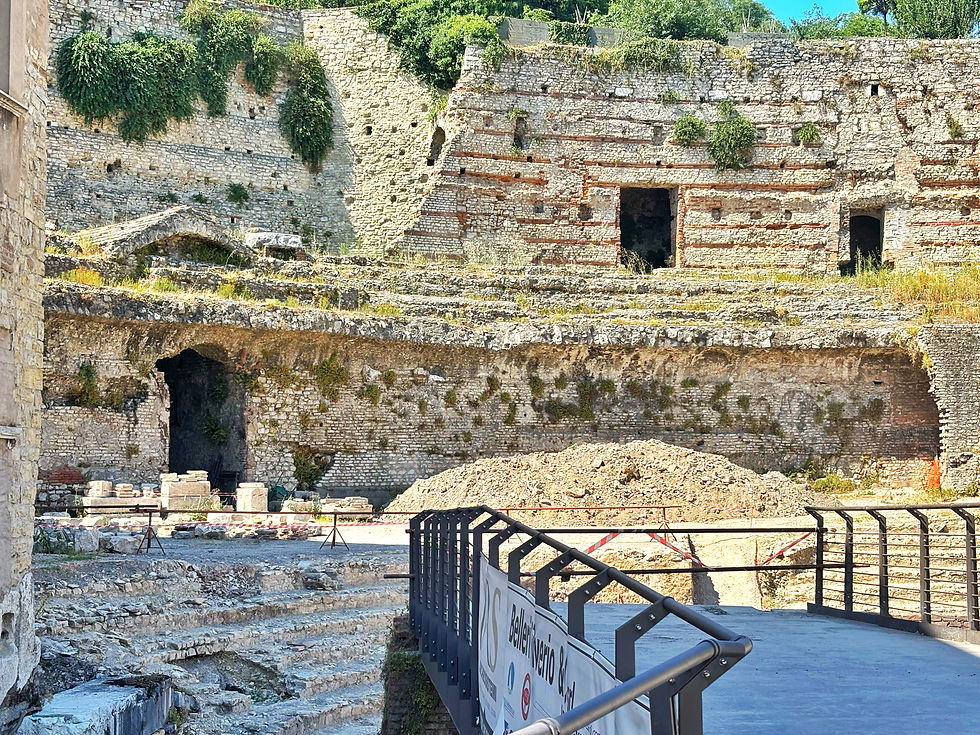
Our free exterior view continued around the complex, where we found another angle over the Teatro Romano from the back and could appreciate the sweep of a venue that once accommodated as many as 15,000 spectators. Seeing the ruins from outside carried its own sense of discovery; the archaeological remains belong to the living city and sit directly beside ordinary streets, which is so cool!
Modern buildings rise nearby as daily routes pass ancient foundations, and behind the streets, the old Roman theatre waits with unwavering patience. That final walk left me all the more eager to return for the museums and paid archaeological areas, since an afternoon had opened the door to Brixia without exhausting the story.

All in All
Brescia stayed with me because the city allowed history to become part of a relaxed family day. Our afternoon began with fast food and gelato in the monumental centre, which carried us between the cathedrals and onward to ancient Brixia. The experience felt personal, in a way, which is often what makes a destination linger in the mind long after the train departs from the station.
With this in mind, Brescia can also easily fill a full weekend with museums and archaeological treasures that deserve patient attention.
A single day also creates enough room for a meaningful introduction, so take the train and spend it walking through the historic centre. Let the city introduce itself at street level, where every old wall seems ready to extend the afternoon by another century.


Comments