


A Closer Look at the Sacred Jerónimos Monastery, Lisbon

Jerónimos Monastery, Lisbon’s religious jewel, offers a personal look at Portugal’s past through a sacred landmark that still shapes the city’s identity today.

I can confidently say that Lisbon has no shortage of beautiful places, but the Jerónimos Monastery has a way of making even the most well-travelled visitor pause mid-step in sheer awe.
You might arrive expecting an impressive historic building, thinking that you’ll take a few photos, admire the famous stonework, and then continue on with your day. Instead, though, you’ll find yourself standing beneath a vast archway, staring upwards as though the ceiling has just challenged you to comprehend it…and you can’t.
In a nutshell, that was my first reaction when I visited.
The monastery feels almost impossibly elaborate, with carved details appearing wherever your eyes land. Ropes twist around columns, stone flowers unfold along doorways, and nautical motifs recall Portugal’s centuries of exploration. Honestly, even the quietest corners seem to have a story tucked into them—or, rather, woven right into the stone itself.

Located in Lisbon’s district of Belém, beside the Tagus River, this remarkable complex brings together religion, royal ambition, architecture, exploration, and national identity all into one gorgeous space. Its attached church adds another layer of beauty, with an enormous vaulted interior and the tombs of some of Portugal’s most celebrated historical figures.
While the entry fee was pretty steep, especially for a comparatively short visit (and I, myself, initially questioned if it would be worth it), I can honestly say the visit offers far more than an opportunity to admire an old monument. It provides a glimpse into the imagination of a country that once looked out across the Atlantic and believed the world could be reached by ship.
For me, visiting at least once is a must when visiting Lisbon!
The Origins of Jerónimos Monastery, Lisbon
The story begins in the late fifteenth century, when Portugal was becoming a major maritime power.
Belém has always sat close to the river and the ships that departed Lisbon, making it an important place for sailors preparing for long, uncertain voyages. Before the present monastery existed, a small chapel dedicated to Santa Maria de Belém stood on the site, where seafarers could pray before beginning their often treacherous journeys.
Later, King Manuel I ordered the construction of the monastery, at the beginning of the sixteenth century. The project served a religious purpose, since the Hieronymite monks were invited to live there, pray for the royal family (can I hire a bunch of people to intercede in prayer for me, too?), and offer spiritual support to sailors.

Essentially, their presence gave the complex a solemn role in Portugal’s expanding empire, tying the daily rhythm of monastic life to the dangerous voyages beyond the harbour.
The monastery was also intended to commemorate Portugal’s growing success overseas.
Vasco da Gama’s voyage to India became particularly important to its identity, because he and his crew are believed to have prayed at the chapel before departing. Thus, when the voyage succeeded, the connection between the explorer, the riverfront, and the monastery grew even stronger in Portugal’s collective memory.
The building reflected the confidence of Manuel I, who ruled during a period of extraordinary wealth and international ambition. Portugal’s trading empire generated the resources to build a monumental complex, and the king used architecture to project his authority; thus, the monastery became a religious foundation, a royal statement, and a celebration of the country’s maritime achievements.
That history also invites a more complicated reflection (as is often the case in history). The monastery’s beauty was supported by the economic success of Portugal’s trading empire… a system involving a whole lot of exploitation, violence, and colonial domination.
Admiring the craftsmanship does not necessitate ignoring the realities behind its construction. Arguably, understanding them actually makes for a more meaningful visit, because the monument becomes a record of ambition and faith, but also of power hungriness and the human cost of an empire.

That all said, the Jerónimos monks remained connected to the complex for centuries, maintaining its religious role while Portugal’s fortunes changed. Their order was eventually dissolved in the nineteenth century, after which the monastery entered a new phase as a national monument.
Walking through it today means moving through several chapters of Portuguese history all at once.
Manueline Architecture in Lisbon
The concept of “Manueline architecture” in Lisbon refers to the ornate style that developed during the reign of King Manuel I, which grew out of late Gothic design while incorporating Renaissance influences and imagery connected to Portugal’s maritime ambitions. At the Jerónimos Monastery, the style reaches its most spectacular expression.
For one, the exterior immediately catches your attention because it’s so richly decorated. Instead of relying on a restrained surface, the builders covered the stone with a seemingly infinite amount of carved details: twisted ropes, armillary spheres, crosses, foliage, shells, and fantastical forms weave through the design.

The effect is theatrical without feeling gaudy, as though the building celebrates every achievement made available to it.
Maritime symbolism is especially important here, with ropes and knots recalling the ships that carried Portuguese sailors across the oceans, while the armillary sphere represents navigation and the mapping of the heavens. These symbols form the building’s central language, allowing the monastery to communicate Portugal’s identity in stone.
The southern portal is one of the most memorable features, rising dramatically across the façade with layers of figures and ornament arranged around the entrance (swoon!). Religious imagery appears alongside royal references, creating a visual relationship between the authority of the Church and the power of the monarchy. You know, before we acknowledged that Church and State need to be separated.
Standing in front of it, I noticed a new detail every few seconds, which made taking a quick photo feel like a good idea.
The proportions of the building add to its impact, thanks to tall windows drawing light into the interior, while slender vertical elements pull the eye upwards. Decorative screens, pinnacles, and carved figures create a sense of movement, even though the material itself is so heavy and permanent. The stone seems to climb, and twist, and unfold across the entirety of the façade.

The Jerónimos Monastery architecture is impressive because decoration never completely overwhelms the structure. Arches, vaults, columns, and entrances remain clear beneath the ornament; that balance gives the complex its strength. It feels exuberant, but it also feels carefully controlled, with every carved surface contributing to a larger architectural composition.
I recommend looking closely at the details around the entrances, where religious references sit beside symbols associated with Portugal’s monarchy and overseas activity. The building’s decorative vocabulary communicates ambition without relying on written explanation.
Even without knowing every symbol, you can sense that the monastery was intended to be admired, remembered, and understood as a statement of national importance.
Exploring the Cloisters and Decorative Details
The cloisters are often the part of the monastery that stays in a visitor’s memory the longest. They surround an open courtyard, creating a calm interior space where the building's scale becomes easier to appreciate. After the elaborate exterior, the cloisters offer a slower experience, encouraging you to walk around the galleries and look closely at the stonework.

Basically, it’s the kind of place that had me repeating over and over again, “Oh, I would totally live here.”
The lower level is lined with elegant arches, each framed by delicate carving. Even on a rainy day like when I had visited, light shifts constantly as it moves across the courtyard, softening the columns and tracery in some places while making the deeper carvings look almost theatrical in others. The atmosphere is peaceful, although the sheer number of details can make your eyes work overtime.
Again, here, the design combines religious symbolism with imagery connected to the Portuguese crown.
Crosses associated with the Order of Christ appear alongside armillary spheres, royal emblems, and plant forms. These motifs helped communicate the monastery’s spiritual purpose while reinforcing Portugal’s growing influence at the time of its construction. The building was designed to inspire prayer, but it also made a rather confident statement about national power.
The corners are particularly rewarding to check out, because the decoration becomes more concentrated in these spaces. Delicate forms gather around the pillars, and the stonework seems to shift as you move from one bay to the next.
This is the sort of place where wandering without a strict plan works beautifully. You may begin by looking at the arches, notice a carved symbol, and then spend several minutes trying to understand a small figure tucked into the surrounding ornament. While the space isn’t huge, per se, the details make you linger for longer than you might originally anticipate.
While I was here, I was determined to get a new profile picture for social media, but after spending so long debating which views of the pillars and towers were best, or whether landscape or portrait was better suited, I had already gone on another trip and had new photos to consider by the time I decided on one. I still love these pictures though, and so I obviously had to include one at the start of this post (ha!).

The courtyard itself creates a surprising sense of openness, too. From the centre, the surrounding galleries form a balanced frame, allowing you to appreciate the monastery’s geometry while remaining surrounded by intricate detail. The open sky above provides a visual pause, which is welcome after the heavily decorated façades and interiors.
The monastery’s history also appears through its changing functions—religious orders were dissolved in Portugal during the nineteenth century, and the complex eventually became connected with national institutions, instead.
Restoration work altered some areas while preserving the building's overall character. So, like many historic monuments, the monastery reflects several periods rather than belonging exclusively to its original construction.
The cloisters invite quiet observation, which is especially welcome after walking through Lisbon’s lively streets. I loved the way the space creates a sense of separation from the city without feeling entirely disconnected from its history.
Beyond the walls, trams rattle along beyond earshot, tourists search for pastries, and the river continues its patient movement. Inside, though, the pace becomes gentler, and the building seems to encourage you to linger a little bit longer.
Inside the Church of Santa Maria de Belém
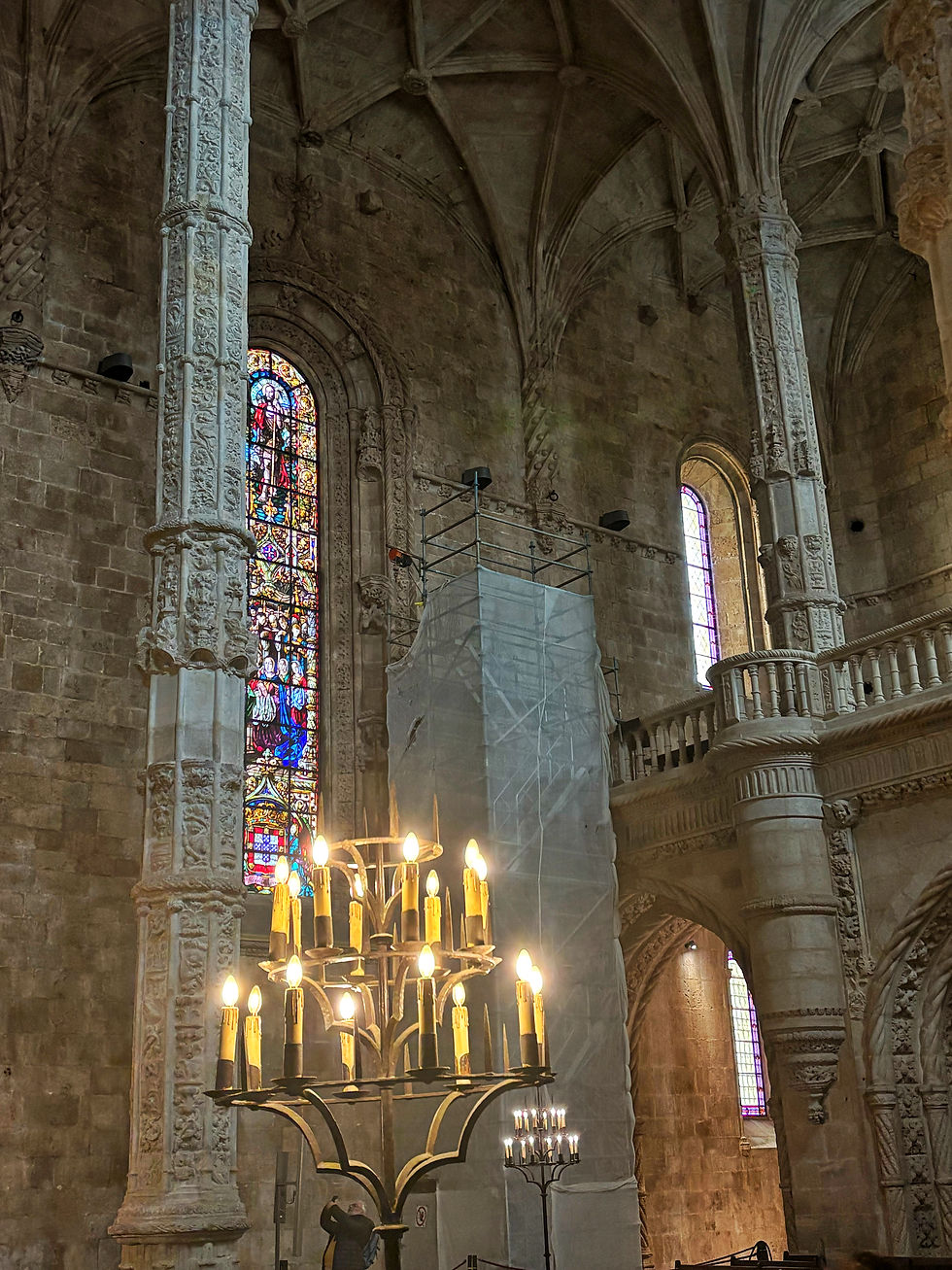
The attached church is known as the Church of Santa Maria de Belém, and entering it feels like moving from elaborate public grandeur into a more spiritual space. The interior is broad and tall, filled with an unusual sense of lightness despite the lack of…well, light. Its vaulted roof appears to float above the nave, supported by slender columns that rise with remarkable elegance.
The church follows late Gothic principles, though its ornament reflects the Manueline period. The columns are especially striking for their height and beautiful proportions, creating a strong vertical rhythm throughout the interior. Looking upwards, you can see how the vaulting spreads across the ceiling, forming a pattern that is both structurally intelligent and visually captivating.
The high choir adds another important element to the interior, sitting above the entrance and giving the church a sense of depth. From below, the arrangement reinforces the building’s verticality, while the details around the choir are a treat for anyone willing to slow down and look carefully.
Plus, the chapels contain religious artwork and decoration from different periods, giving the church a layered visual character.
Carved wood, painted surfaces, gilded details, and sculptural elements work together to create a setting that feels rich without becoming chaotic. Light filtering through the coloured windows shifts the mood as you move through the space, making some areas feel warm and intimate while others feel more solemn.
The church remains an active place of worship, which shapes the experience in an important way. It’s not simply a historic interior preserved for visitors—religious services continue here, and that ongoing purpose gives the building a living quality.
Even when you are focused on the architecture, it’s worth remembering that people have prayed within these walls for centuries, and that the church remains part of Lisbon’s present.

The scale can be slightly overwhelming, especially when you first enter, and so I recommend giving yourself time to adjust, rather than trying to understand the entire interior immediately. Stand near the centre, look towards the ceiling, and then allow your attention to move slowly through the nave. We actually walked around a few times, having entered well before our time ticket to the monastery itself!
This is a church that rewards patience.
Notice how the church’s vertical lines guide your attention towards the heavens; that movement is central to Gothic religious design, yet the Manueline decoration gives the space a distinctly Portuguese character. The result feels both monumental and intimate, which may explain why the church remains so memorable even long after the details begin to blend together in your pictures.
The Tombs of Portugal’s Great Figures
The tombs inside the church are among the most moving features of the complex because they connect the vast architecture with individual lives. The most famous are the tombs of Vasco da Gama and Luís de Camões, positioned in the lower choir near the entrance. Their presence simultaneously connects the church to Portugal’s maritime and literary identity.
As I mentioned earlier, Vasco da Gama is remembered for reaching India by sea in 1498, a voyage that transformed Portugal’s international position. His tomb is decorated with maritime references, reflecting the importance of navigation to his legacy.
Seeing it within this church creates a striking connection between the sailor who departed from Belém and the monument that commemorates Portugal’s overseas expansion.

Nearby lies the tomb of Luís de Camões, Portugal’s great poet. His epic poem, Os Lusíadas, celebrated Portuguese exploration and helped shape the cultural memory of the Age of Discoveries. Camões gives the church a literary dimension, reminding visitors that poetry, not only monuments, military achievements, and royal ceremonies, preserves national history.
The tombs themselves date from the nineteenth century, when the remains of both men were transferred to the church. Their placement reflects the way later generations shaped the monastery’s identity, choosing which figures should represent Portugal’s past.
While the tombs are highly decorated, they remain recognizable as memorials to individuals, rather than disappearing into the surrounding architecture.
The royal tombs are located in the chancel, where members of the Portuguese royal family were laid to rest. King Manuel I and his wife, Maria of Aragon, are represented alongside King João III and Catherine of Austria. Their tombs rest on sculpted elephants, an extraordinary detail that reflects the exotic imagery associated with Portugal’s global connections during the period.

The arrangement of the royal tombs also reinforces the monarchy's relationship with religion, as the rulers are commemorated within a church built under royal patronage, surrounded by imagery that reflects both divine authority and dynastic power. The result is grand, but it also feels deeply human when you consider the people represented there and the generations who have stood nearby to mourn them.
What stayed with me most was the way the tombs bring the monastery’s vast story down to a personal scale. It’s easy to think about ships, trade routes, royal wealth, and national ambition in broad historical terms.
Another remarkable literary figure rests within the monastery itself: Fernando Pessoa, one of Portugal’s most celebrated poets and writers. His tomb can be found in the cloisters, where its simple, modern design creates a very striking contrast with the intricate Manueline stonework surrounding it.
Pessoa wrote under several literary personas, each with a distinct voice and identity. This unusual approach made his work especially imaginative, while also reflecting his interest in the many sides of human experience. His presence at Jerónimos Monastery adds a more modern literary chapter to a place so strongly associated with Portugal’s royal and maritime past.
Standing beside Pessoa’s tomb is a quiet experience, as the surrounding cloisters are filled with elaborate carvings—the memorial itself, however, feels restrained and contemplative. It really is a beautiful reminder that the monastery’s story continued long after Portugal’s great voyages, carrying the country’s cultural memory into the twentieth century.
Standing beside any of these memorials, you’re reminded that those stories belonged to real people who carried hopes, fears, beliefs…and egos. History becomes more tangible when a name is carved into stone, doesn’t it?
The monastery’s memorials also demonstrate how Portugal has chosen to remember its past. The figures represented here are associated with exploration, literature, monarchy, and national achievement. Their presence encourages visitors to consider which stories have been celebrated most prominently, and how monuments continue shaping the way history is understood.
All in All
A visit to Jerónimos Monastery, Lisbon, brings together extraordinary architecture, religious history, royal ambition, and Portugal’s maritime legacy. The cloisters invite quiet reflection, while the attached church offers an unforgettable vaulted interior and the tombs of figures who continue to shape the country’s identity.
You absolutely must make time for this stunning monument during your travels in Lisbon.
Look closely, pause often, and allow yourself to appreciate the details without rushing. Whether you love history, architecture, religion, or just have an appreciation for beautiful places with complicated stories, the monastery deserves to be experienced in person.


Comments