


Musei Capitolini: A Must-Visit Museum in Rome for Travellers

Visiting Musei Capitolini reveals Rome’s history through art, stories, and setting, offering a memorable museum experience on Capitoline Hill in Rome.

Personally, I am most drawn to museums that feel like invitations, not obligations. The kind that pull you in quietly, without fanfare, until you realize you have been standing in front of the same statue for ten minutes, slightly emotional, wondering how a piece of marble survived empires, earthquakes, revolutions…and, now, your phone camera.
That was my experience the first time I walked into the Musei Capitolini—no rushing, no ticking boxes. It felt like Rome had decided to tell a story slowly, and I was welcome to stay as long as I liked.
I had seen the exterior multiple times, even peeking into its garden behind a locked gate after hours. From outside its walls, I had wanted to visit this museum for a couple of years before I finally got to go. When I eventually did, it was absolutely worth it.
Perched above the city on Capitoline Hill, this museum does not shout for attention the way some Roman landmarks do. It does something far more dangerous.
It assumes you are curious.
It assumes you care about layers, about details, about how a place becomes what it is.
If you are the type of traveller who wants to understand a destination, rather than just skim it, this is where Rome really starts to make sense.
Musei Capitolini and Rome’s Living Memory
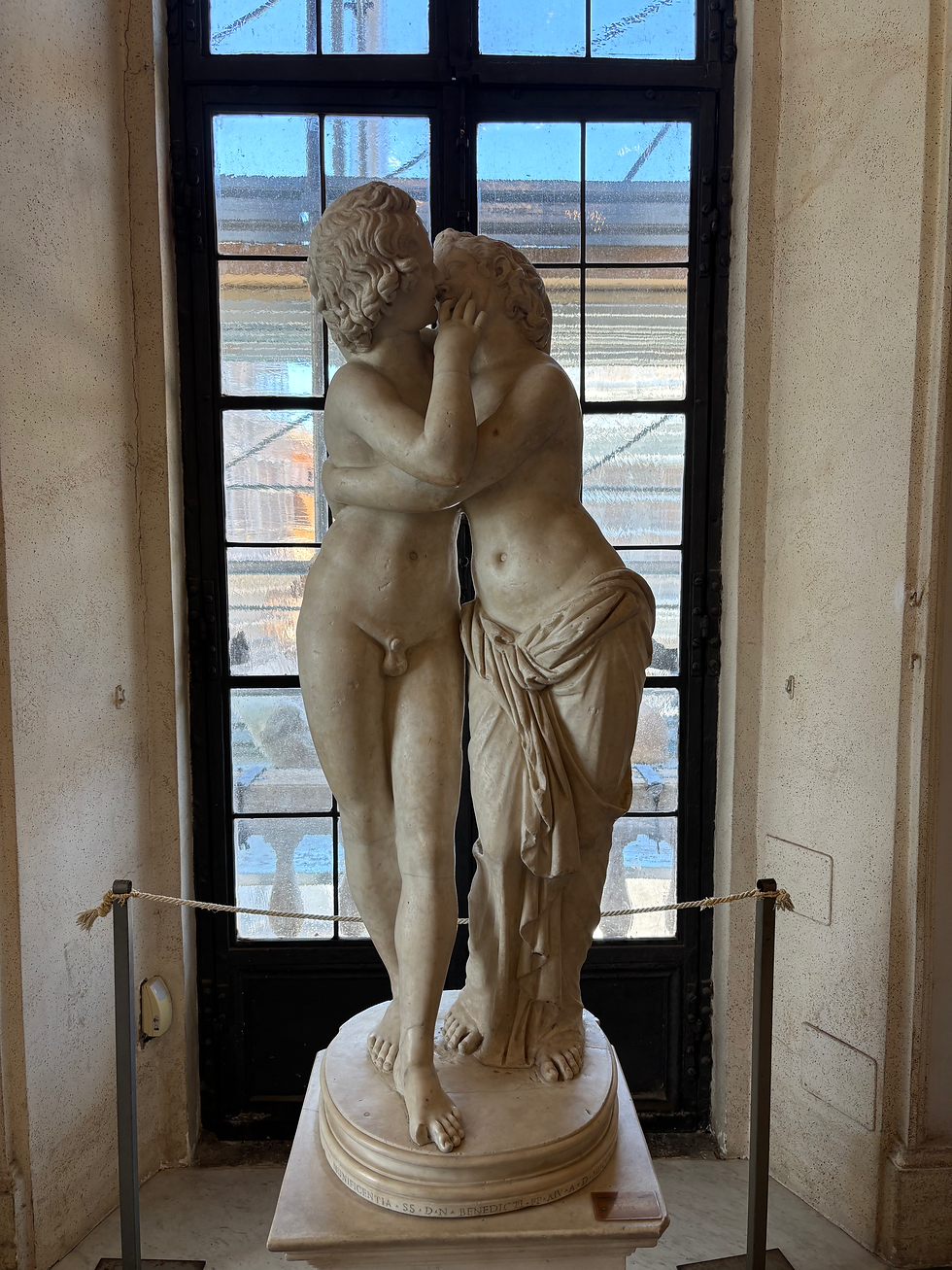
Walking into the Musei Capitolini (Capitoline Museums) feels like stepping into a private conversation Rome has been having with itself for over two thousand years. The buildings are elegant without being intimidating, designed to guide you, not overwhelm you. Here, every room carries a sense of continuity that is rare even in a city famous for history layered on history.
While wandering through the halls, it’s clear that you are doing so with intention, walking through a narrative that begins with the city’s mythic origins and unfolds with remarkable clarity.
The statues greet you with a calm authority; they are not posed for drama, but for permanence, and that tone sets the pace for the entire visit. There is a sense of respect baked into the space, an understanding that these works were never meant to be rushed past or reduced to photo opportunities.
Instead, the museum invites you to slow down, read inscriptions, notice expressions, and absorb how power, faith, and civic pride shaped the ancient world.
The layout encourages wandering with intention, offering long sightlines through galleries that connect eras without spelling everything out. You move naturally from gods to emperors to philosophers, piecing together how art functioned as messaging long before marketing departments existed.
It becomes clear that this was never about decoration alone. These objects were statements, declarations of identity carved in stone.
What struck me most was how intimate the experience felt. Despite housing some of Rome’s most significant artifacts, the atmosphere remains almost conversational. You do not feel dwarfed. You feel included. It is the rare museum that manages to balance importance with approachability, and that balance makes the stories land harder.
By the time you reach the windows overlooking the city, the connection clicks into place. The Rome outside suddenly feels like an extension of what you have been seeing inside. Streets, ruins, churches, and piazzas stop feeling random. They feel like chapters in the same long book.

(And the best part? If you’re a resident of Rome—short- or long-term—it’s free to enter the Musei Capitolini with the MIC Card!)
Palazzo dei Conservatori at Musei Capitolini
Walking into the Palazzo dei Conservatori feels like entering a civic living room where Rome has been collecting its most meaningful objects for centuries. The scale of the rooms immediately sets the tone, with soaring ceilings and richly decorated halls that make you lift your head before you even notice what is on the walls.
Frescoed chambers tell stories of Roman identity and civic pride, wrapping history around you, rather than pinning it behind glass. Sculptures appear at almost every turn, including the legendary Capitoline Wolf statue, which somehow manages to feel both monumental and oddly familiar.
Renaissance paintings add another layer, reminding you that Rome never stopped reinventing itself even after antiquity faded. What stays with you most is the sense that this building was designed to impress visitors and citizens alike, a reminder that art and power have always been closely linked here.
Inside this room, you can also see remains linked to the Temple of Jupiter Optimus Maximus, once the most important religious structure in ancient Rome. Standing here is incredible, the remnants of a temple that still remains quietly powerful, especially knowing this temple crowned Capitoline Hill long before emperors ruled the city.

From this large space within the museum, you can walk directly outside into the Capitoline Gardens, where the past suddenly scales up in dramatic fashion.
Rising above the courtyard is the approximately 12-metre-tall (about 40 feet) colossal reconstructed statue of Constantine the Great, offering a complete vision of the same figure whose massive hand, foot, and head fragments greet visitors when entering the Musei Capitolini courtyard.
Seeing Constantine fully reassembled in the open air transforms those fragments into a commanding presence, grounding abstract history in something unmistakably human and unforgettable. It’s the perfect way to start off your time in the museum.
Capitoline Galleries and Rome’s Visual History
The Capitoline Galleries unfold gradually across both Palazzo dei Conservatori and Palazzo Nuovo, revealing Rome’s visual history as something layered, intentional, and deeply tied to power. Moving through these spaces feels less like wandering a museum and more like tracing how the city chose to see itself over time.

The Hall of the Emperors creates an arresting moment, with rows of sculpted faces lining the walls as though locked in an eternal exchange. Some appear stern, others contemplative, and together they form a silent record of authority, ambition, and legacy.
The Capitoline Picture Gallery shifts the atmosphere entirely, drawing you into painted scenes filled with colour, movement, and emotion, where religious devotion, mythological storytelling, and civic pride take centre stage.
Sculpture halls bring yet another tonal change, balancing idealized forms with portraits that feel almost uncomfortably human in their realism. Throughout the galleries, the layout feels deliberate and restrained, allowing each room to breathe and each theme to register without sensory overload.
By the time you finish, it becomes clear why the Capitoline Museums in Rome feel so essential to understanding the city. They do not simply display Rome’s past, they show how Rome chose to remember it.
The Tabularium and Rome’s Ancient Archives

The Tabularium often surprises visitors by becoming one of the most memorable spaces in the entire complex, precisely because it does not try to impress at first glance. Built in the first century BC, this former Roman state archive feels raw, grounded, and quietly powerful.
Walking through its stone corridors feels like stepping into the operational heart of the ancient city, where laws were recorded, civic decisions preserved, and the machinery of empire quietly functioned. The vaulted passages carry a physical weight that mirrors the importance of what was once stored here, creating a rare sense of proximity to Rome’s administrative past.
Today, the Tabularium connects the two main museum buildings, transforming a simple transition into a journey through time.
Open arches along the route frame expansive views of the Roman Forum and Palatine Hill, encouraging unhurried pauses that feel almost cinematic. Fragments of inscriptions and architectural elements appear throughout, grounding the experience in tangible evidence and reinforcing the idea that Rome’s art, politics, and daily governance were never separate worlds, but parts of the same living system.
Palazzo Nuovo and Ancient Roman Sculpture

The Palazzo Nuovo delivers a markedly different rhythm, one that feels calm, almost meditative, as you move from room to room.
Dedicated almost entirely to ancient sculpture, the building invites a slower pace, where repetition becomes grounding rather than monotonous. Marble figures stand in composed stillness, each revealing a quiet confidence shaped by centuries of viewing. Emperors meet your gaze with carefully carved authority, philosophers appear suspended in thought, and gods seem entirely at ease within their idealized forms.
The 18th century layout reinforces this sense of order, encouraging you to absorb small details, from the precise marbled folds of a toga to the soft curl of carved hair. Natural light filters in gently, creating shifting shadows that animate the sculptures without overwhelming them.
In this setting, the essence of a Roman art museum becomes unmistakably clear, with history presented as something to be studied slowly, thoughtfully, and with full attention.
Piazza del Campidoglio and the Heart of Rome
The Piazza del Campidoglio is not an interior gallery, yet it feels every bit as intentional as the rooms inside the museum. Designed by Michelangelo, the square unfolds with a quiet theatricality, guiding you through space rather than demanding your attention.

Subtle curves and precise symmetry shape the way you move, encouraging an unhurried approach that feels almost instinctive. The patterned paving draws your eye inward, gently slowing your pace and grounding you in the moment before anything else competes for focus.
Surrounding buildings rise with calm authority, framing the square in a way that feels protective rather than imposing. There is a strong sense of balance here, where grandeur and intimacy coexist without tension.
Standing in the centre, it becomes clear that this is not simply a passage between museum buildings. It is the opening chapter of the experience, a ceremonial pause that allows you to shed the noise of the city below. By the time you step forward again, your expectations have subtly shifted, and you are fully prepared to see with what lies beyond.
Palazzo Senatorio and Capitoline Hill Design

At the centre of the square stands the Palazzo Senatorio, a building that anchors the entire hill with quiet authority. It functions as Rome’s City Hall and remains largely closed to museum visitors, yet its presence shapes the experience from every angle.
The façade rises with a sense of permanence, resting on ancient foundations that subtly reveal how many eras coexist beneath the present day.
As you move across the square, the central tower becomes a steady visual reference point, gently drawing your eye back toward the core of the space. The design reflects the unmistakable hand of Michelangelo Buonarroti, whose influence extends beyond individual details and into the emotional balance of the entire setting.
Proportions feel deliberate, sightlines feel considered, and nothing appears accidental. Standing nearby, you begin to understand that this hill was conceived as a unified civic statement rather than a collection of separate buildings.

The Palazzo Senatorio reinforces the idea that here, architecture, governance, and public life were designed to coexist in harmony, shaping how the city presents itself both to its citizens and to those passing through.
All in All
If you are planning a trip to Rome and want an experience that deepens your understanding of the city rather than skimming its surface, make space for the Musei Capitolini. Give it time. Wander without urgency. Let yourself get absorbed.
This is not a museum you squeeze in between other plans. It is a place that deserves attention, curiosity, and a slower pace. In return, it offers insight that follows you through every street, ruin, and piazza that comes after.
When you stand on Capitoline Hill, looking out over the city with centuries of history behind you, Rome stops being overwhelming and starts feeling legible. That alone is worth the visit.


Your Musei Capitolini visit, photos, and review capture the history and unique presence it holds in all that Rome has to offer. I never cease to be impressed by how well they have preserved antiquity unlike many other countries that are bent on modernizing everything.
This is such a great spotlight on Musei Capitolini, it truly is one of Rome’s most fascinating museums. I also wrote about Rome on my travel blog, and posts like yours are so helpful for inspiring deeper exploration beyond the usual highlights.
Walking through those halls sounds way better than rushing through the usual tourist traps. I love when a museum actually lets you breathe and connect with the art. That view over the city is a perfect finish.
I always wanted to travel the world, and Rome is one of the places I want to visit. So much rich history there, and so much to see! I also want to try "real" pizza!
So many gorgeous photos. Th galleries with the gold look so beautiful and Capitoline Venus. I would love to see all of this in person one day for sure.