


Balat, Fener, and Süleymaniye: The Golden Horn Walk

Balat, Fener, and Süleymaniye reveal Istanbul's centuries-long history, which continues to shape colourful streets and everyday neighbourhood life today.
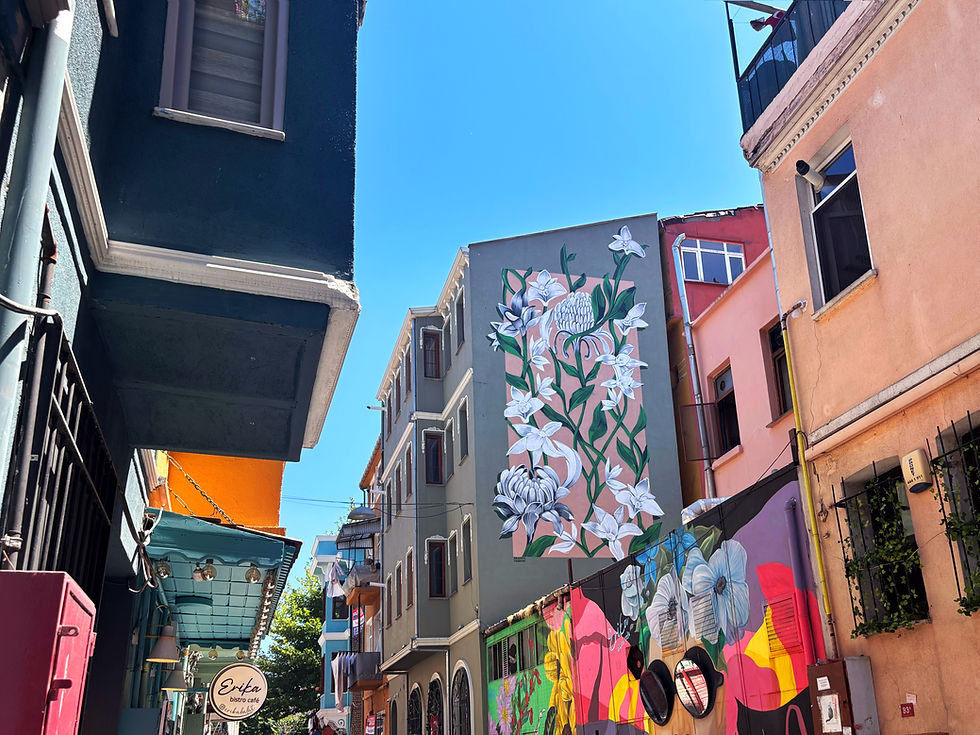
There’s this talent that Istanbul has for turning a planned afternoon into a story you could never have scheduled in advance.
You might set out with your Maps app open, your camera in hand, and then find yourself beside an outdoor stove while a woman who speaks no English presses dough beneath her palms and waves you closer. Soon, you attempt to copy a technique she has clearly mastered through years of practice, communicating through smiles as lunch takes on a life of its own.
This is the sort of day Balat and Fener can give you.
These neighbouring quarters along the Golden Horn incite curiosity, all while simultaneously encouraging unhurried sightseeing. Their sloping streets hold houses in shades that seem chosen to challenge the Istanbul sky, while places of worship reveal how many communities have called this area home.
Old buildings now hold cafés or artisan workshops as ordinary routines unfold around centuries-old monuments. Nearby, Süleymaniye adds another perspective through its Ottoman architecture and far-reaching views.
My friends and I arrived in this pocket of the city wanting to see the famous streets and landmarks, particularly in Balat and Fener. The moments that ended up staying with us arose spontaneously, though; we followed an interesting staircase, then entered a boutique on a whim. Later, we accepted an unexpected invitation to make flatbread.
So, yes: Balat, Fener and Süleymaniye deserve unhurried attention because their stories live between the destinations marked on your map, and you’ll discover this in the most magical way possible.
Balat, Fener, and Süleymaniye Through Time

The Golden Horn has carried people tied to trade and faith throughout Istanbul’s history, and the neighbourhoods along its southern side still reflect that movement.
Balat and Fener sit side by side within Fatih, with a boundary that is easy to miss while walking; however, each retains a distinct identity within a story woven through centuries of migration. Süleymaniye rises closer to the historic commercial centre, where its mosque complex has shaped the surrounding streets since the Ottoman period.
Balat became closely associated with Istanbul’s Jewish community, particularly after Sephardic Jews expelled from Spain arrived in the Ottoman Empire near the end of the fifteenth century. Jewish families built lives around the neighbourhood’s synagogues and markets, while Greek Orthodox residents also formed part of its social fabric.
Population shifts changed Balat over time, and its religious buildings and domestic architecture continue to speak to the people who made their homes here.
Fener developed as a centre of Greek Orthodox life under Ottoman rule, becoming home to influential Greek families (often called “Phanariots”), some of whom served the empire as diplomats or administrators.
The arrival of the Ecumenical Patriarchate around 1600 strengthened the neighbourhood’s importance far beyond Istanbul. Today, the Patriarchate and the commanding red form of the Fener Greek Orthodox College make that history visible across the gorgeous Golden Horn.

Süleymaniye, however, grew around an imperial vision: Sultan Süleyman the Magnificent commissioned a religious and civic complex to express Ottoman power while serving the surrounding city. The mosque stood at its heart, with institutions dedicated to education and public welfare nearby.
Its towering presence influenced local homes and businesses, creating an urban landscape that integrated imperial architecture into daily life.
Among the historic neighbourhoods in Istanbul, these three offer an unusually intimate way to understand the city’s layered identity, especially from a religious perspective. History appears in a church wall and continues in the angle of an old upper storey, while residents follow familiar routes home with their groceries. Tourism, meanwhile, has brought new cafés and restored façades, especially in Balat.
One of the most beautiful things about it all? Today, these remain lived-in communities, and the beautiful doorway in your photograph may also be someone’s front door!

Sacred Landmarks and Their Stories
Beside the Golden Horn, Sveti Stefan Church looks almost delicate, which is quite an achievement for a building made from prefabricated iron. An earlier wooden church served Istanbul’s Bulgarian Orthodox community during its campaign for greater ecclesiastical independence, but the components of the present building were produced in Vienna before travelling along the Danube and across the Black Sea.

Assembled in Istanbul, the church opened in 1898. You can see how its history undeniably connects remarkable architecture with the community’s search for a distinct religious voice.
St. George’s Cathedral, meanwhile, presents a restrained exterior and immense spiritual significance. The former convent church became the home of the Ecumenical Patriarchate around 1600, making it central to Eastern Orthodox Christianity. Fires and later rebuilding altered the structure over the centuries.
Inside, the carved iconostasis draws your gaze toward the sanctuary, while treasured relics deepen the sense of continuity and (despite the eeriness that these reliquaries sometimes have) remain beautiful. Its modest scale makes the experience feel personal when you enter with the respect expected in an active cathedral.
Higher in Fener, Meryem Ana Rum Ortodoks Kilisesi, also called the Church of Saint Mary of the Mongols, carries an extraordinary thread of Byzantine history. Its roots reach back to a seventh-century foundation, while the surviving church is associated with Maria Palaiologina, who returned to Constantinople after marrying the Mongol ruler Abaqa Khan and supported a convent here during the late thirteenth century.
The church remained in use by the Greek Orthodox Church after the Ottoman conquest and was never converted into a mosque. Access can be limited, so confirm arrangements before climbing…or, even if you can’t get inside (we didn’t), it’s nonetheless still well worth admiring from outside the gates!

For travellers planning a visit to Süleymaniye, Istanbul, the Süleymaniye Mosque serves as the neighbourhood’s natural anchor. Süleyman the Magnificent commissioned Mimar Sinan to create the complex, which was constructed during the 1550s and inaugurated in 1557. Sinan balanced the vast dome with an interior filled with soft daylight, giving the prayer hall a remarkable sense of calm.
The wider complex once supported learning and charitable work, while the tombs of Süleyman and Hürrem Sultan connect the site to the imperial family that shaped it. It’s also an incredible bit of Istanbul’s history you can easily access!
While these are all interesting things to do in Istanbul, remember that each landmark remains tied to faith, so visit with care and awareness. Services can affect access, and opening arrangements may change around religious observances.
At the churches, wait for permission before photographing worshippers, and remember that sacred areas may have their own rules. Süleymaniye expects modest clothing, and touring the interior outside prayer times shows consideration. A quiet approach gives you time to absorb the architecture and atmosphere in all of these spaces.
Colourful Streets and Ottoman Architecture
Balat’s painted houses have become social media favourites, and the surrounding streets add depth to the famous images you see floating around online.

Kiremit Caddesi is known for its colourful façades, and nearby lanes unveil peeling paint alongside careful restoration that has been taking place over the years. You’ll likely spot laundry fluttering above the pavement as residents chat across windows, bringing movement to scenes that photographs make appear frozen. Really, it brings a beautiful sense of life to your travels.
The steep terrain continually changes your view, sometimes revealing the Golden Horn after a climb that your calves will remember. Seriously. My legs have still not forgotten.
Merdivenli Yokuş is another rewarding place to pause with a camera, thanks to its stepped slope and tightly packed buildings. Projecting upper floors respond cleverly to the hill, giving the street a theatrical quality through architecture alone. An earlier visit may bring softer light and more room, though people remain part of the scene throughout the day. Balat’s streets belong to its residents, so patience and courtesy matter when taking photographs.
Fener brings a more solemn visual character. The Fener Greek Orthodox College rises above the rooftops in red brick, earning it the nickname of “the Red School.” Founded centuries before the current nineteenth-century building appeared, the institution remains a powerful marker of Greek life in the city.

Nearby houses lean into steep streets where bay windows create shifting shadows that make the space all the more pretty. The climb can feel ambitious, but the changing perspectives offer plenty of encouragement to keep going.
The area’s domestic architecture reveals how Istanbul adapted through repeated fires and changing tastes. For example, where wood once dominated many residential streets, masonry later became more common as rebuilding progressed.

Nineteenth-century terraced houses often feature upper-storey projections that increase living space above narrow plots; polished restorations now stand near buildings carrying visible traces of age. Together, they show a city continually repairing itself, with each generation leaving evidence in the materials that they opt to use.
Browsing the small shops became one of our favourite things to do in Balat, Istanbul. We found boutiques filled with handmade pieces and curious objects that felt entirely distinctive to the area. I ended up with sugar skull-designed espresso cups, a watercolour painting of the Bosphorus with the Hagia Sofia towering above it, and a pair of cute handmade earrings.
Enter the places that catch your eye, even when you had no intention of shopping. Ceramics might lead you through one door, while a window of vintage finds pulls you through another. The pleasure comes from meeting makers and finding something with a story attached to it.
Where Balat’s Daily Life Meets the Table
Like many places in Istanbul, food offers one of the easiest ways to slow your pace in Balat.
Outdoor tables give the main café streets a lively energy. Along a quieter lane, a tiny kitchen may send wonderful smells into the street. Tea arrives at the right moment after a steep climb, and a meal gives you permission to watch the neighbourhood move around you. Choosing where to stop becomes a very important debate when every doorway offers a convincing reason to sit down and stay a while.
We chose New Balat Café Restaurant after reading Google reviews of nearby places, and the decision led to one of our favourite experiences of the day. The food was fantastic, with the kind of flavour that makes conversation pause as everyone concentrates on the plate in front of them (but also encourages everyone to want to share a bite with each other, so no dish goes untried).

The waitstaff welcomed us warmly, creating a relaxed atmosphere from the beginning. We had expected a good lunch and would have left completely happy with that alone, but we actually got so much more out of the meal.
Outside the restaurant, a woman was preparing a delicious flatbread dish on a stove. She spoke no English, and we didn’t share enough of a common language for a conventional conversation, but our mutual interest in cooking and food fostered a unique form of “discourse.” Friendliness did all the necessary translating for us.
In the middle of our meal, between appetizers and our main course that we ate on the outdoor patio, she invited us closer with a wave to see how she handled the dough, then encouraged us to try making it ourselves. With patient gestures, she turned our restaurant stop into a miniature cooking workshop that no itinerary could have predicted.

Trying to shape and cook the dough beside her made the meal feel real, if that makes sense. Our technique may not have revealed any hidden talent in Turkish cooking, and the experience gave us a story that we still talk about. She treated our attempt with good humour, and the restaurant staff shared the same warmth when they brought it to us on a little platter once it had fully cooked through.
Encounters like this are why meals can become an important part of visiting Fener and Balat, Istanbul.
Süleymaniye has its own culinary traditions, with local restaurants around the mosque long associated with kuru fasulye, a comforting white-bean dish often served with rice. While we didn’t have the opportunity to try any this time, it clearly would make a satisfying pause after exploring the complex, particularly on a cooler day.
Wherever you eat, allow appetite and curiosity to guide the choice. After all, here, lunch may become the highlight you never saw coming.
An Istanbul Neighbourhood Walking Tour
Begin at Süleymaniye in the morning, when you have fresh legs for the hill and time to appreciate the mosque without watching the clock. Walk through the courtyard and enter the prayer hall when visitor access permits, then look across the Golden Horn. That view provides context for the day ahead, since Fener and Balat sit along the water in the direction you will follow.
The descent also feels kinder than saving Süleymaniye’s climb for late afternoon (but if you’re brave enough and you do, the sunset views would be phenomenal).
From the mosque area, make your way downhill toward Küçükpazar and the Golden Horn, checking your map as the lanes bend around busy roads. The waterfront route leads through Cibali toward the Ecumenical Patriarchate and St. George’s Cathedral, where some stretches are functional city streets; thus, give road crossings your full attention.
The changing neighbourhood texture reveals how closely these quarters connect within Fatih.
From the Patriarchate, climb into Fener for the Church of Saint Mary of the Mongols before passing the Fener Greek Orthodox College. After, descend toward the waterfront and Sveti Stefan Church, whose iron silhouette is easy to recognize, and whose structure is a quick and gorgeous spot to enter for a visit.

Throughout all of this, you’ll find that the slopes make comfortable shoes a wise decision, and polished stones can become slippery in wet weather. Nonetheless, pause along the uphill route, whether the weather is perfect or less than ideal, and appreciate the architectural details you might otherwise miss when all your attention is devoted to reaching the top.
From here, drift west into Balat after exploring Fener, following whichever residential streets and shopfronts draw your attention. This is where a tightly timed route becomes less useful.
Spend time around Merdivenli Yokuş before browsing the boutiques, then settle in for a meal when hunger wins. The neighbourhood’s appeal depends on unscripted pauses, and rushing through its best-known photo locations would miss so much of what makes it so very memorable.
Personally, I’d plan to spend the better part of a day on the full route if you enjoy photography and long meals. The night before you plan to set out, double-check the current access details for religious sites.
When your feet eventually raise that white flag of defeat and let you know that negotiations have ended, the T5 Tram serves both Balat and Fener, with connections toward Eminönü. That easy return lets you wander without retracing every slope on foot.
All in All
Balat, Fener, and Süleymaniye reveal Istanbul through neighbourhood life as well as through a gorgeous monumental history. A cathedral sits within an ordinary street, while a centuries-old church hides behind a high wall. From the hill, an imperial mosque watches over neighbourhood life.
History feels close here, and the most meaningful memories you make may come from a shopkeeper’s welcome or a shared attempt at making dough.
When you travel to Istanbul, give these neighbourhoods the better part of a day, leaving enough room for a promising doorway, alley, or colourful stairwell to change your plans. Come for the multicoloured houses and remarkable landmarks, then stay for the human moments that make the city feel personal.
You’re about to see how much of Istanbul lives beyond its familiar skyline, trust me.


Comments