


Top Historical Sites in Paris Beyond the Eiffel Tower
- Emily Fata
- 3 hours ago
- 10 min read

Plan your trip around the top historical sites in Paris, from the Louvre and Catacombs to Versailles, Père Lachaise, Saint-Denis, and grand royal gardens.

Paris has a remarkable ability to make history feel deeply personal, as if the city itself has decided to sit beside you at a café table and quietly tell stories about revolutions, royal scandals, artistic movements, and centuries of dramatic human ambition while you sip an espresso that costs far more than you likely planned to spend.
During my first trip to the French capital, I expected beautiful architecture, exceptional pastries, and enough museum fatigue to require a recovery croissant by mid-afternoon, yet what surprised me most was how emotionally immersive the city felt from the moment I arrived.
One minute, you can be standing inside a palace that once housed French kings, and the next, you’re descending into underground tunnels lined with human bones while questioning every horror film decision anyone has ever made.
That’s all to say, Paris doesn’t separate its past from the present. History lives everywhere here, woven into public squares, hidden beneath busy streets, lingering inside cathedrals, and resting quietly within garden pathways where locals now jog with baguettes tucked under their arms as though that is the most ordinary thing in the world.
That is what makes exploring the top historical sites in Paris such an unforgettable experience for travellers who genuinely want to understand a destination as a whole—whether it’s your first time visiting the city or you’re visiting the city again for the tenth time. These places reveal the beauty, complexity, brilliance, and occasional chaos that shaped France into what it is today.
Top Historical Sites in Paris: The Louvre
Few places embody the grandeur of Paris quite like the Louvre Museum, which manages to feel both impossibly elegant and mildly overwhelming…particularly once you realize that attempting to see everything in one visit is an optimistic fantasy best left to fictional movie montages. I’ve been twice, and there are absolutely still things that I’ve missed there.
Long before it became the world’s most visited museum, the Louvre began as a medieval fortress in the late twelfth century before evolving into a royal palace that housed generations of French monarchs.

Walking through the museum feels like moving through multiple centuries all at once; ancient Egyptian artifacts, Renaissance masterpieces, Greek sculptures, and lavish royal apartments exist beneath one enormous roof that somehow still leaves visitors constantly checking maps and wondering how they ended up in another hallway filled with priceless paintings.
The museum’s famous glass pyramid adds a modern architectural contrast against the historic palace exterior, creating one of the most recognizable Paris historical landmarks for travellers arriving in the city.
Beyond iconic works like the Mona Lisa and Venus de Milo, visitors should spend time exploring the lesser-known sections of the museum, including the preserved medieval fortress foundations hidden below ground level, where thick stone walls reveal how deeply rooted Parisian history truly is.
The surrounding courtyard and the nearby Seine River also create a wonderfully atmospheric setting for a post-visit wander, especially during golden hour, when the historic façades seem to glow softly above the bustling crowds.
Place de la Concorde in the French Revolution
At first glance, Place de la Concorde appears refined and peaceful, with decorative fountains, elegant statues, and sweeping views stretching toward the Champs Élysées (even though its beautiful appearance masks one of the darkest chapters in French history).
During the French Revolution, this square became the site of public executions carried out beneath the guillotine, including those of King Louis XVI and Queen Marie Antoinette. This was back when the space was called ‘Place de la Révolution.’
Standing in the square today creates a strange emotional contrast, because tourists snap cheerful holiday photos while standing in the same location where revolutionary crowds once gathered to witness executions that transformed the course of French history forever.

Fun fact: I came here 223 years to the day after Marie Antoinette was beheaded (12:15 p.m. on October 16, 1793) to stand at the spot and pay a quiet tribute to her, at the exact same time just after noon.
The towering Luxor Obelisk at the centre of the square dates back more than three thousand years and was gifted to France by Egypt in the nineteenth century, adding another fascinating historical layer to an already complex location.
The fountains inspired by the city of Rome provide beautiful visual symmetry, while the surrounding architecture reflects the elegance associated with eighteenth-century Parisian design.
From here, visitors can easily walk to the Tuileries Garden, the Seine River, or the Champs Élysées, making the square an excellent starting point for exploring some of the most famous monuments in Paris while absorbing the atmosphere of a city that has continually reinvented itself over centuries.
La Conciergerie and Medieval Paris
Tucked along the banks of the Seine on the Île de la Cité, La Conciergerie offers one of the most haunting glimpses into medieval Paris and the violence of the French Revolution. Originally part of the royal palace complex during the Middle Ages, the building later became a prison where countless political prisoners awaited trial and execution during the Reign of Terror.
The most famous inmate was undoubtedly Queen Marie Antoinette, whose reconstructed prison cell remains one of the most emotionally powerful spaces in the building; it strips away the glamour often associated with royal history, replacing it with an atmosphere of fear, uncertainty, and isolation.

Walking through the stone halls and cavernous Gothic chambers feels almost cinematic, particularly when sunlight filters through the towering medieval windows, illuminating the cold interiors.
The Hall of the Guards and the Hall of Soldiers reveal the immense scale of medieval royal architecture, while exhibits throughout the building help contextualize the human stories connected to the prison during one of France’s most turbulent periods.
Outside, the Seine River and neighbouring Notre Dame area create a striking contrast between beauty and tragedy, reminding visitors that many of the historic places to visit in Paris carry stories that are both extraordinary and deeply unsettling.
Jardin du Luxembourg’s Royal Charm
After exploring darker chapters of Parisian history, the peaceful atmosphere of Jardin du Luxembourg feels like an invitation to breathe more slowly and appreciate the softer side of the city’s past. I mean, unless you like the doom and gloom, in which case, gloss over this section and move on to the next (you won’t be disappointed).
Commissioned in the early seventeenth century by Marie de’ Medici, the gardens were inspired by the royal landscapes of Florence and remain one of the most beloved green spaces in Paris today.
The Luxembourg Palace overlooks perfectly manicured lawns, fountains, flowerbeds, and tree-lined promenades where locals gather to read, relax, and occasionally engage in extremely competitive games of pétanque that, honestly, should qualify as Olympic events based on the intensity alone.

One of the loveliest aspects of the gardens is how effortlessly they combine elegance with daily life, allowing visitors to feel immersed in Parisian culture, rather than separated from it. It’s the perfect place to stretch out your legs while sitting on a park bench, eating a sandwich for lunch while listening to birds chirping and people chatting as they wander past you/
Children sail miniature boats across the central fountain while students from nearby universities lounge in green chairs beneath chestnut trees, creating a wonderfully timeless atmosphere that feels largely unchanged despite centuries passing around it.
Statues of queens, poets, and historical figures line the pathways, adding cultural depth to an already beautiful setting and reinforcing why these gardens remain among the most treasured Paris heritage sites for travellers seeking a quieter historical experience.
Inside the Catacombs of Paris
Okay, we’re getting a bit dark again. History often is, though, as I’ve come to accept.
There are few experiences in Europe quite as memorable as descending into the Catacombs of Paris, largely because most people do not expect a city celebrated for romance and pastries to also contain a vast underground labyrinth filled with the remains of more than six million people.
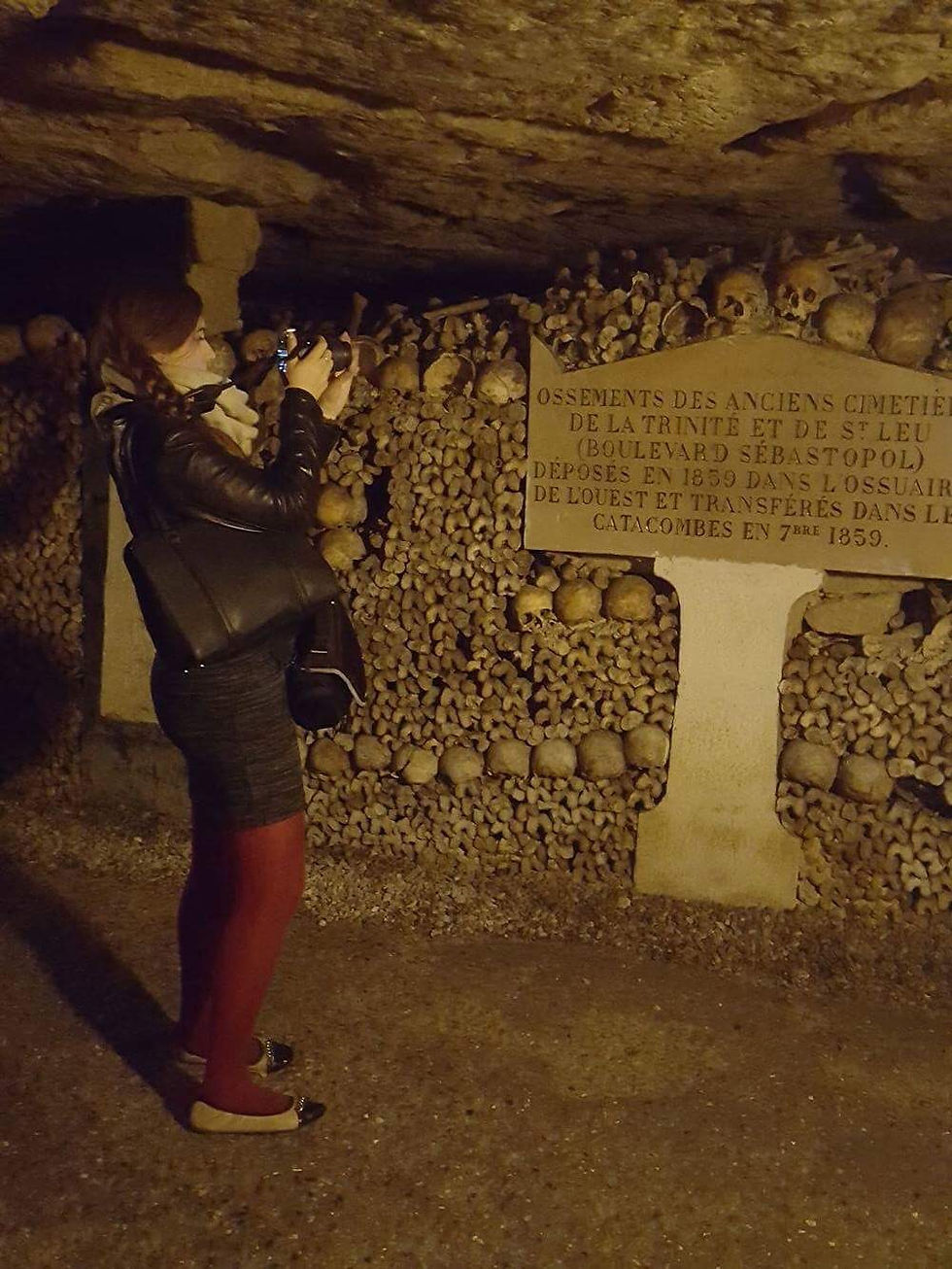
Yet, beneath the elegant boulevards of Paris lies an eerie network of tunnels, formed from former limestone quarries that later became ossuaries in the late eighteenth century.
Public cemeteries in Paris had become dangerously overcrowded, creating sanitation concerns throughout the city, so human remains were transferred underground in carefully arranged formations that continue to fascinate and unsettle visitors today.
Walking through the narrow passageways lined with skulls and bones feels surreal, particularly once the silence settles around you and the scale of the site becomes fully apparent. In some places, you’re mere centimetres away from grazing bones as you pass through the pathway.
Historical plaques throughout the tunnels explain the origins of the catacombs and the practical reasons behind their creation, while the carefully organized arrangements reveal how even death became intertwined with artistry and symbolism in Paris.
Although the experience can feel unsettling at times, it also provides a fascinating perspective on how cities evolve beneath the surface, both literally and culturally. It is impossible to leave without thinking differently about the layers of history hidden beneath modern urban life.
Père Lachaise’s Legends
Among the must-see historical attractions Paris offers travellers, Père Lachaise Cemetery remains one of the most atmospheric and unexpectedly beautiful places to explore. Established in the early nineteenth century, the cemetery quickly became the final resting place for artists, writers, musicians, and political figures whose influence shaped global culture.
Visitors wander through cobblestone pathways lined with elaborate tombs, ivy-covered mausoleums, and sculptural memorials that resemble an open-air museum more than a traditional cemetery.
Graves belonging to Oscar Wilde, Édith Piaf, Frédéric Chopin, and Jim Morrison attract visitors from around the world, although getting mildly lost while searching for them feels almost inevitable because the cemetery’s winding pathways seem determined to challenge everyone’s sense of direction.

What makes Père Lachaise so compelling is the emotional atmosphere created by the blend of history, artistry, and quiet reflection. Some visitors leave handwritten notes or flowers at famous gravesites, while others simply wander slowly through the peaceful grounds, appreciating the surrounding architectural beauty.
There are also legends surrounding graves that people have historically interacted with. For example, Victor Noir (Division 92), where legends claim to kiss his statue’s lips for love, to rub the trousers area for a lively sex life, and to touch his feet brings a pregnancy of twins.
There’s also the Dragon Grave (Division 57), the first sculpture placed in the cemetery, which is sometimes touched for luck (although it’s less famous than Noir). At Oscar Wilde’s Grave (Division 89), while not for "good luck," for many years, there was a tradition to leave lipstick kisses on his tomb.
However, I want to emphasize that this is now widely discouraged or illegal, as it damages these gravesites, which should be treated with respect. Plus, many of these ‘legendary tombs’ are protected by glass barriers now, for good reason.
Regardless of whose graves you visit, the cemetery offers incredible views of Paris from elevated pathways, creating moments when the city appears simultaneously vibrant and contemplative.
Moulin Rouge Within Belle Époque Paris
Although many travellers associate Moulin Rouge with bright lights and glamorous performances, the famous cabaret also represents an important chapter in Parisian cultural history, linked to the artistic explosion of the Belle Époque.

Opened in 1889 near the bohemian neighbourhood of Montmartre, the Moulin Rouge quickly became a gathering place for artists, performers, writers, and musicians who shaped Paris's creative identity in the late nineteenth century.
The venue became particularly associated with painter Henri de Toulouse Lautrec, whose iconic posters immortalized the cabaret’s dancers and performers while helping to define the era's visual culture.
While I recommend seeing the performance at least once in your lifetime, even visitors who choose not to attend a show can appreciate the historical significance of the building itself and the surrounding Montmartre district, where steep cobblestone streets, hidden staircases, and lively cafés continue to preserve the neighbourhood’s artistic spirit.
Walking through the area at night feels wonderfully theatrical, with glowing signs, music drifting from bars, and bustling terraces that still echo the energy of historic Parisian nightlife. Although modern performances lean heavily on entertainment, the cabaret remains deeply connected to the city’s creative legacy and its enduring fascination with spectacle, freedom, and artistic expression.
Basilique Saint-Denis and its Royal History
Located slightly outside central Paris, Basilique Saint-Denis deserves far more attention than it typically receives from international travellers because it houses the tombs of dozens of French kings and queens in one of the world's earliest Gothic cathedrals.

The basilica’s soaring architecture, stained-glass windows, and elaborate royal monuments create an atmosphere that feels profoundly significant to anyone interested in French royal history.
Many visitors overlook Saint Denis in favour of larger attractions, which honestly works in your favour, as the quieter atmosphere gives you time to absorb the details without battling enormous crowds or being accidentally struck by someone aggressively wielding a selfie stick. The sculpted tombs reveal centuries of changing artistic styles while illustrating how the monarchy shaped France for generations.
The basilica also played a critical role in the development of Gothic architecture, particularly through its innovative use of light and its vaulted ceilings, which later inspired cathedrals across Europe.
Walking through the nave feels peaceful and reflective, especially when sunlight streams through the stained glass, illuminating centuries-old stonework that has survived wars, revolutions, and dramatic social change.
The Palace of Versailles Extravagance
For travellers willing to venture beyond the city centre, the Palace of Versailles offers one of the grandest experiences in France and easily earns its reputation as one of the top historical sites in Paris and the surrounding areas. Originally a hunting lodge, Versailles was transformed by King Louis XIV into an enormous royal palace and became the ultimate symbol of French monarchy and aristocratic excess.
The Hall of Mirrors remains the most famous room in the palace (and one of the most opulent places in Paris and the surrounding area), where glittering chandeliers, gilded details, and towering windows create an atmosphere so lavish that it almost feels like fiction.
Visitors can also explore the royal apartments, ceremonial halls, and beautifully preserved interiors that reveal how French royalty lived before the Revolution dramatically changed the country forever.

Outside, the palace gardens stretch endlessly with sculpted hedges, fountains, hidden groves, and pathways designed to impress visiting dignitaries with displays of wealth and power. Not to mention the Grand and Petit Trianons and the Queen’s Hamlet, all of which are truly magnificent to see.
Renting a bicycle or rowing boat on the grounds adds another layer of fun to the visit, particularly after several hours spent admiring so much gold detailing that you wonder whether subtle interior decorating had simply not been invented yet (and regretting that since then, it has been).
All in All
Paris rewards travellers who slow down enough to truly absorb its stories. Here, history is never confined to museums alone; it lives within gardens, prisons, cemeteries, theatres, royal palaces, and public squares, where generations of people have shaped the city's identity through moments of brilliance, creativity, tragedy, and transformation.
Regardless of whether you find yourself wandering through the Louvre, descending into the catacombs, or watching the sunset along the Seine after a long day of exploring, these extraordinary sites create memories that remain vivid long after you return home.
If you have been dreaming about visiting France, let Paris pull you into its remarkable past and experience these unforgettable historical locations for yourself. Few cities in the world make history feel this alive.


Comments